ZeroAlloc.Scheduling.Redis
2.2.10
dotnet add package ZeroAlloc.Scheduling.Redis --version 2.2.10
NuGet\Install-Package ZeroAlloc.Scheduling.Redis -Version 2.2.10
<PackageReference Include="ZeroAlloc.Scheduling.Redis" Version="2.2.10" />
<PackageVersion Include="ZeroAlloc.Scheduling.Redis" Version="2.2.10" />
<PackageReference Include="ZeroAlloc.Scheduling.Redis" />
paket add ZeroAlloc.Scheduling.Redis --version 2.2.10
#r "nuget: ZeroAlloc.Scheduling.Redis, 2.2.10"
#:package ZeroAlloc.Scheduling.Redis@2.2.10
#addin nuget:?package=ZeroAlloc.Scheduling.Redis&version=2.2.10
#tool nuget:?package=ZeroAlloc.Scheduling.Redis&version=2.2.10
ZeroAlloc.Scheduling




ZeroAlloc.Scheduling is a source-generated background job scheduler for .NET 8, 9 and 10. Decorate any class with [Job] and the source generator wires up the executor, DI registration, and recurring startup automatically — no reflection, no convention scanning at runtime.
Install
The source generator is bundled into the main package — a single PackageReference is all you need:
dotnet add package ZeroAlloc.Scheduling
dotnet add package ZeroAlloc.Scheduling.InMemory   # or EfCore / Orm / Redis
The standalone
ZeroAlloc.Scheduling.Generatorpackage is still published for backwards compatibility with existing direct PackageReferences, but new consumers should reference onlyZeroAlloc.Scheduling.
Example
using System.Text.Json.Serialization;
using Microsoft.Extensions.DependencyInjection;
using ZeroAlloc.Scheduling;
using ZeroAlloc.Scheduling.InMemory;
using ZeroAlloc.Serialisation;

// 1. Define jobs — the generator picks them up automatically.
//    [ZeroAllocSerializable] plus a JsonSerializerContext give each job an AOT-safe serializer,
//    because the store persists every job as bytes.
[Job(Every = Every.Hour)]
[ZeroAllocSerializable(SerializationFormat.SystemTextJson)]
public sealed class CleanupExpiredSessionsJob : IJob
{
    public ValueTask ExecuteAsync(JobContext ctx, CancellationToken ct)
        => ctx.Services.GetRequiredService<ISessionRepository>().DeleteExpiredAsync(ct);
}

[Job]
[ZeroAllocSerializable(SerializationFormat.SystemTextJson)]
public sealed record SendOrderConfirmationJob(int OrderId) : IJob
{
    public ValueTask ExecuteAsync(JobContext ctx, CancellationToken ct)
        => ctx.Services.GetRequiredService<IOrderMailer>().SendConfirmationAsync(OrderId, ct);
}

[JsonSerializable(typeof(CleanupExpiredSessionsJob))]
internal sealed partial class CleanupExpiredSessionsJobJsonContext : JsonSerializerContext;

[JsonSerializable(typeof(SendOrderConfirmationJob))]
internal sealed partial class SendOrderConfirmationJobJsonContext : JsonSerializerContext;

// 2. Register — the generated Add...Job() methods wire each executor, and the recurring startup
//    for CleanupExpiredSessionsJob. AddSerializerDispatcher() is generated by ZeroAlloc.Serialisation,
//    which ZeroAlloc.Scheduling brings in; see docs/migrating-to-v2.md.
services.AddSerializerDispatcher();
services.AddScheduling()
        .WithInMemoryStore()
        .AddCleanupExpiredSessionsJob()
        .AddSendOrderConfirmationJob();

// 3. Enqueue a one-off job from application code
public class OrderService(IScheduler scheduler)
{
    public async Task CompleteOrderAsync(Order order, CancellationToken ct)
    {
        await ProcessAsync(order, ct);
        await scheduler.EnqueueAsync(new SendOrderConfirmationJob(order.Id), ct);
    }
}
Performance
Head-to-head vs Coravel 6.0.2 (de-facto in-process scheduler) and a hand-rolled BackgroundService + Timer baseline. BenchmarkDotNet 0.15.8, .NET 10.0.13, measured 2026-10-15. Allocations are exact. Speed is shown as same-run ratios, because the benchmark host is a shared VM; absolute timings are not published.
| Operation | Coravel | Naive Timer | ZA.Scheduling |
|---|---|---|---|
| Job registration | 696 B per Schedule() call |
— (compile-time) | compile-time, 0 B at runtime |
| Single dispatch | (registration only) | indistinguishable from an empty method, 0 B | indistinguishable from an empty method, 0 B |
Honest reading: Coravel's Schedule() is a runtime call that allocates a queue entry; 100 calls allocate 76,320 B and take 15.36× as long as one in the same run. ZA.Scheduling's [Job] registration happens at compile time via source generation — no equivalent runtime cost. For dispatch overhead, ZA matches a hand-written Timer: BenchmarkDotNet cannot tell either from an empty method. The value of the abstraction is [Job] itself (declarative retries / cron / store-backed persistence), not raw dispatch speed.
Full methodology + design analysis: docs/performance.md.
Features
- Source generator —
[Job]on a class emits a typed executor, DI extension method, and optional recurring startup (IHostedService) - Recurring jobs —
[Job(Cron = "0 * * * *")]or[Job(Every = Every.Hour)]— scheduled via Cronos at startup - Retry with backoff — exponential retry up to
MaxAttempts(per-job or global); dead-letters after exhaustion - Multiple backends — InMemory (dev/test), EF Core (SQL Server / PostgreSQL / SQLite), ZeroAlloc.ORM, Redis
- Dashboard — embedded HTML/JS dashboard via
app.MapJobsDashboard("/jobs") - Blazor component —
<JobsDashboard>Razor component for integration into Blazor apps - Mediator bridge —
[Job]+IRequest<Unit>auto-registersMediatorJobTypeExecutor<T>, routing execution through ZeroAlloc.Mediator pipeline behaviors - Native AOT compatible — no reflection at runtime; all dispatch resolved at compile time
Dashboard
An embedded HTML/JS dashboard — summary cards for each job state, a live-refreshing table with per-row requeue / delete actions, and fully responsive down to mobile widths.
app.MapJobsDashboard("/jobs");

// Optional: protect with auth
app.MapJobsDashboard("/jobs").RequireAuthorization("AdminPolicy");
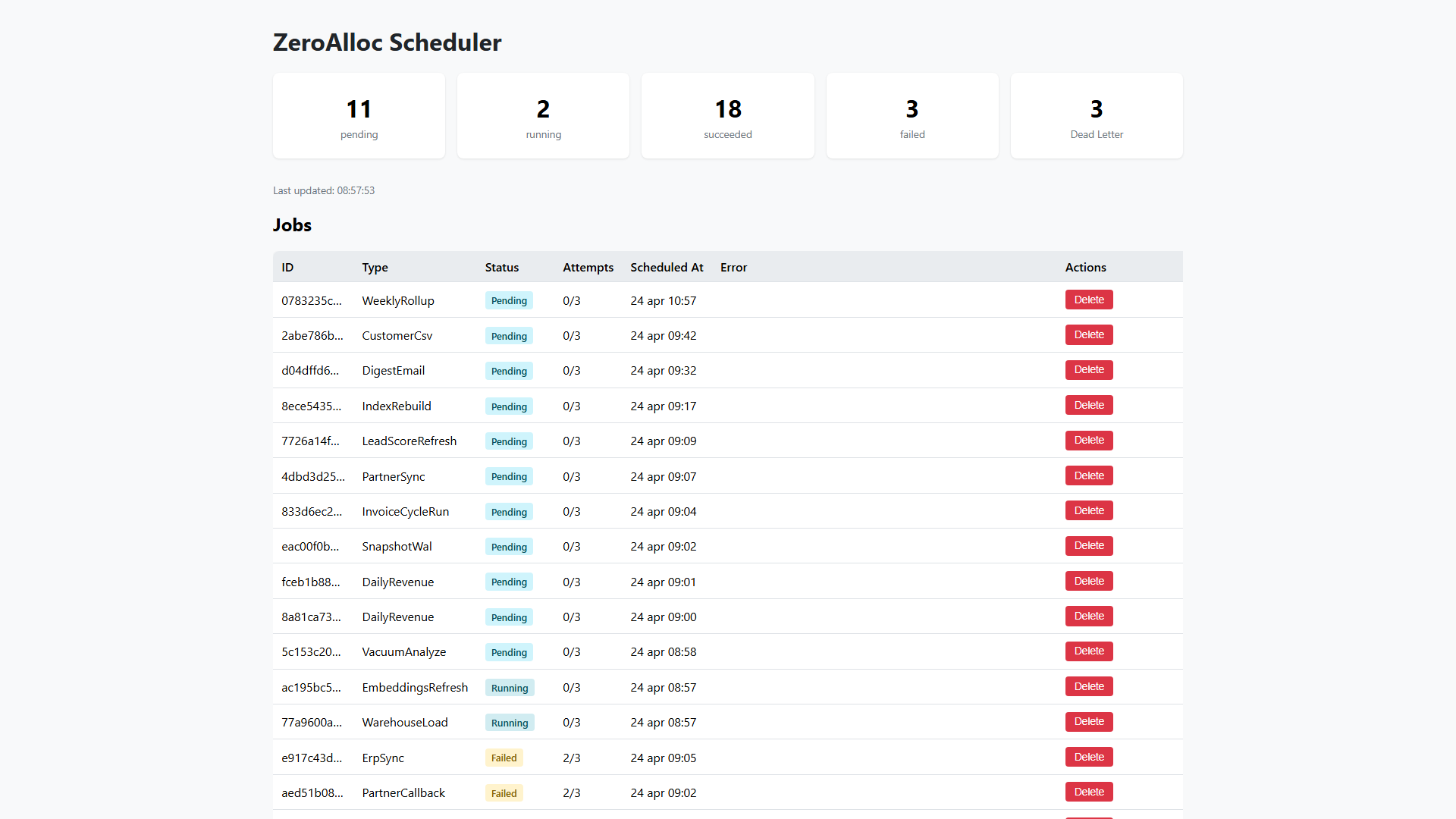
Tablet (768 × 1024) and mobile (375 × 812) captures live in docs/screenshots/.
See Dashboard for the full endpoint reference and the Blazor component.
Packages
| Package | Description |
|---|---|
ZeroAlloc.Scheduling |
Core interfaces, worker service, scheduler, bundled source generator |
ZeroAlloc.Scheduling.Generator |
Source generator — legacy, already bundled inside ZeroAlloc.Scheduling |
ZeroAlloc.Scheduling.InMemory |
In-process store for development and testing |
ZeroAlloc.Scheduling.EfCore |
EF Core store (SQL Server, PostgreSQL, SQLite) |
ZeroAlloc.Scheduling.Orm |
ZeroAlloc.ORM store (SQLite, PostgreSQL, SQL Server), WithOrm(); net10.0 only |
ZeroAlloc.Scheduling.Redis |
Redis store for distributed deployments |
ZeroAlloc.Scheduling.Dashboard |
Embedded HTML dashboard (MapJobsDashboard) |
ZeroAlloc.Scheduling.Dashboard.Blazor |
Blazor component library |
ZeroAlloc.Scheduling.Mediator |
ZeroAlloc.Mediator bridge |
ZeroAlloc.Scheduling.Resilience |
ZeroAlloc.Resilience bridge: retry, timeout and circuit-breaker around job execution |
ZeroAlloc.Scheduling.Telemetry |
ZeroAlloc.Telemetry bridge: OpenTelemetry spans and metrics for job execution (WithTelemetry()) |
Documentation
| Page | Description |
|---|---|
| Getting Started | Install and schedule your first job in five minutes |
| Source Generator | [Job], Every, Cron, generated extension methods |
| Backends | InMemory, EF Core, and Redis store configuration |
| Dashboard | Embedded HTML dashboard and Blazor component |
| Mediator Bridge | Route job execution through ZeroAlloc.Mediator |
| Resilience Bridge | Wrap job execution in ZeroAlloc.Resilience policies |
| Telemetry Bridge | OpenTelemetry spans and metrics for job execution |
| Migrating to v2 | The serializer choice 2.0 made explicit, and the AOT-safe job setup |
| Diagnostics | ZASCH001, ZASCH011, ZASCH012 and ZASCH013 compiler diagnostic reference |
| Performance | Throughput, allocation profile, and tuning guide |
License
MIT
| Product | Versions Compatible and additional computed target framework versions. |
|---|---|
| .NET | net8.0 is compatible. net8.0-android was computed. net8.0-browser was computed. net8.0-ios was computed. net8.0-maccatalyst was computed. net8.0-macos was computed. net8.0-tvos was computed. net8.0-windows was computed. net9.0 is compatible. net9.0-android was computed. net9.0-browser was computed. net9.0-ios was computed. net9.0-maccatalyst was computed. net9.0-macos was computed. net9.0-tvos was computed. net9.0-windows was computed. net10.0 is compatible. net10.0-android was computed. net10.0-browser was computed. net10.0-ios was computed. net10.0-maccatalyst was computed. net10.0-macos was computed. net10.0-tvos was computed. net10.0-windows was computed. |
-
net10.0
- StackExchange.Redis (>= 3.4.0)
- ZeroAlloc.Scheduling (>= 2.2.10)
-
net8.0
- StackExchange.Redis (>= 3.4.0)
- ZeroAlloc.Scheduling (>= 2.2.10)
-
net9.0
- StackExchange.Redis (>= 3.4.0)
- ZeroAlloc.Scheduling (>= 2.2.10)
NuGet packages
This package is not used by any NuGet packages.
GitHub repositories
This package is not used by any popular GitHub repositories.
| Version | Downloads | Last Updated |
|---|---|---|
| 2.2.10 | 0 | 10/15/2026 |
| 2.2.9 | 104 | 10/12/2026 |
| 2.2.8 | 91 | 10/12/2026 |
| 2.2.7 | 109 | 10/11/2026 |
| 2.2.6 | 168 | 10/11/2026 |
| 2.2.5 | 114 | 10/11/2026 |
| 2.2.4 | 102 | 10/11/2026 |
| 2.2.3 | 91 | 10/11/2026 |
| 2.2.2 | 99 | 10/10/2026 |
| 2.2.1 | 109 | 10/10/2026 |
| 2.2.0 | 110 | 10/10/2026 |
| 2.1.0 | 117 | 10/10/2026 |
| 2.0.17 | 94 | 10/10/2026 |
| 2.0.15 | 97 | 10/9/2026 |
| 2.0.14 | 87 | 10/7/2026 |
| 2.0.13 | 103 | 10/7/2026 |
| 2.0.12 | 93 | 10/6/2026 |
| 2.0.11 | 99 | 10/4/2026 |
| 2.0.10 | 99 | 10/3/2026 |
| 2.0.9 | 95 | 10/2/2026 |